We use our own and third-party cookies for analytical and technical purposes, processing data necessary to create profiles based on your browsing habits. You can find more information and configure your preferences in 'Cookie Settings'.
 Back
Back
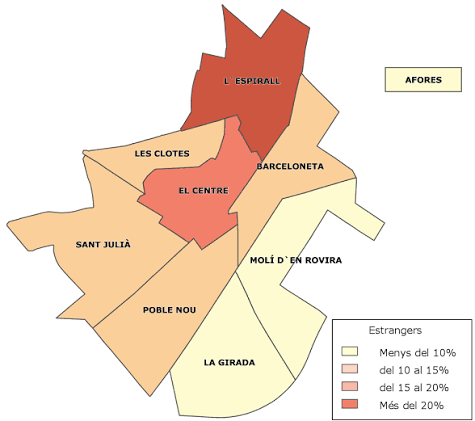
Vilafranca is structured in eight neighborhoods that unfold like the petals of a bouquet around the historic center. In the heart of the walled town we find medieval streets —Parellada, Ferrers— and emblematic squares such as the Villa, the Constitution or Sant Joan; unique buildings such as the Palau Reial, the Casa de la Vila, Cal Bolet or the Casino of 1876 coexist with commercial centers full of life.
To the northwest extends the Espirall, spanned by Avenida de la Pelegrina. It is a medium density neighborhood that houses the Regional Hospital, the Mossos police station, the Bombers Park and the CAP Nord, in addition to the NAU youth space. The Espirall beats especially during the summer festivities, when the entities organize their own parades and correfocs.
Next to the railway line, Barceloneta-Sant Magí concentrates the train station and logistics activity; Igualada, Barcelona and Santa Clara streets connect with the station square and a series of intimate passages that preserve the memory of the industrial expansion of the 20th century.
La Girada, on the southern side of the road, is the youngest neighborhood: blocks of fluffy houses, a wooded promenade that leads to the large artificial grass park 1 d'Octubre and the bus station make up a modern space that continues with the neighboring neighborhood of Molí d'en Rovira, historically industrial but with the picturesque Carrer del Comerç, qualified It is considered one of the most beautiful façade lines in Catalonia.
El Poble Nou, born in the 1960s, is today the most populated neighborhood. The Tivoli Park, the long avenue Amàlia Soler and a network of educational and sports facilities give it personality. Further to the southeast, Sant Julià — second in population — combines sports areas, the eponymous park and the Pla del Diable with the Rambla de Catalunya, the civic axis of the sector.
Les Clotes, to the west, stands out for the Torres i Bages library, the former Slaughterhouse converted into a cultural space and squares such as La Verema or the Gas. Finally, the set of neighborhoods is completed with the small residential fabric of the Molí d'en Rovira on both sides of the stream.
Outside the town, four neighbourhoods dot the area: Cal Salines, the road to Santa Margarida i els Monjos, with origins in an old salt mill; the Bordellet, to the north-east, named after the memory of a medieval border; the scattered Molí d'en Rovira, centred on the old mill and a monastery dedicated to the Mare de Déu del Pilar; and Pere Pau, next to Sant Pere Molanta. Each one still maintains the rural beat and recalls the peasant physiognomy that, despite modernity, continues to define the soul of Penedès.


 CAT
CAT ESP
ESP FRA
FRA POR
POR ITA
ITA ALE
ALE NLD
NLD ZH
ZH JA
JA