We use our own and third-party cookies for analytical and technical purposes, processing data necessary to create profiles based on your browsing habits. You can find more information and configure your preferences in 'Cookie Settings'.
 Back
Back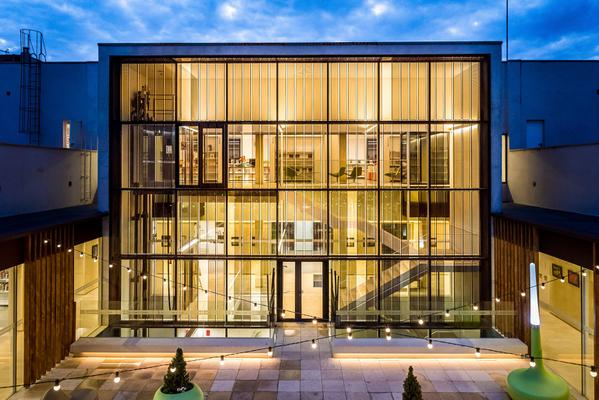
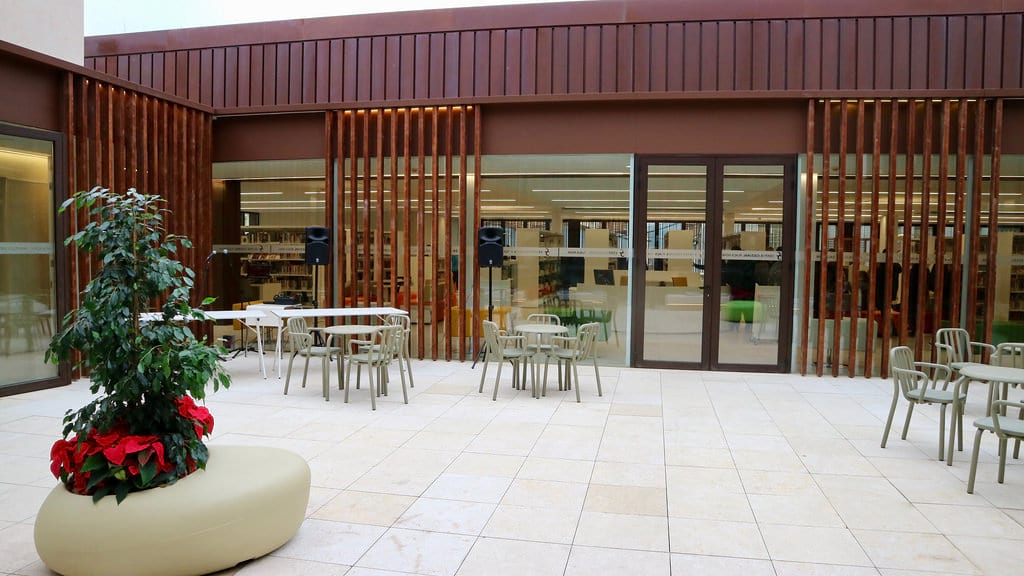
In the heart of the cultural complex that today houses the Ramon Bosch de Noya Municipal Library, the former cloister offers one of the most surprising — and, at the same time, the most unknown — heritage spaces of Sant Sadurní d'Anoia. Although the municipal documentation does not precisely detail its origin, its typology recalls the small porched courtyards of the 19th century Penedesco peasant houses: a closed rectangular floor, surrounded by a gallery of stone columns that support lowered arches and which, on the upper floor, give way to a corridor with a wrought iron railing. This courtyard was the backbone of the old school of the Carmelite Sisters, a building that, with successive extensions and reforms, was transformed into the public library inaugurated in 1996.
Architecturally, the cloister preserves the original stone screed on the capitals and foundations, where small flint marks can still be read. The pavement is solved with terracotta slabs placed in a herringbone, drained in the center by a slit today blinded but still visible. On the south side, an imperial staircase communicates directly with the newspaper library on the noble floor; to the west, a large arched window connects with the children's room, creating a dialogue between the reading silence and the zenith light that bathes the courtyard.
Since the renovation in 2012, the cloister has become a multipurpose space for exhibitions and cultural events. During the Fairs and Festivals, one of the most intimate sections of the program is celebrated here: pictorial exhibitions such as “El que enigoro” by Clàudia Carbó (5-28 September 2025) or community installations that invite the neighbors to dialogue with art. There are also book presentations, small-format concerts and children's workshops, taking advantage of the freshness of the porch and the magnificent natural sound of the venue.
The integration of modern elements — recessed LED lighting, accessible accesses for people with reduced mobility and a cable concealment system — has been done with great respect for the original appearance. A small plaque commemorates the donation of the Bosch de Noya family, local patrons with a long tradition, thanks to which the museumization of the space was completed.
Today, to visit the cloister is to meet again with the calm of a shaded courtyard that, despite not being a large monument in dimensions, preserves the daily memory of generations of Sadurninac schoolchildren and readers. It is a good example of how the modest heritage, well cared for and open to the public, can become an engine of cultural vitality and a meeting point of the neighborhood, without losing the half-monastic, half-civil charm that its serene architecture gives it.


 CAT
CAT ESP
ESP FRA
FRA POR
POR ITA
ITA ALE
ALE NLD
NLD ZH
ZH JA
JA